
Adam Smith made an uncomfortable distinction in The Wealth of Nations that his admirers often skip over. He separated labor that creates lasting, compounding value – the kind that builds something – from labor that is consumed the moment it is produced and leaves nothing behind. The distinction was contested in 1776, and it remains contested today. But it is exactly the right lens for understanding where most businesses are failing with AI right now.
The majority of enterprise AI deployment today is, by Smith’s definition, unproductive. Not because it is useless in the moment – it often saves real time and real effort – but because it does not compound. A salesperson uses AI to draft an email faster. A marketing team generates ten blog posts instead of three. Time is saved. The output is consumed. And the organization ends up exactly where it started, except with a larger Microsoft or Google bill. This is not a technology failure. It is a leadership vacuum.
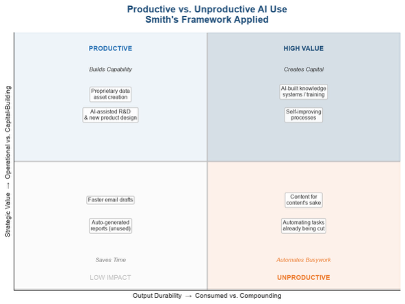
When no one inside the business is accountable for how AI creates value – not just how it saves time – organizations default to automation of existing busywork. What no one is measuring is whether any of it compounds into something the organization did not have before: new capability, proprietary knowledge, a process that gets better over time. That is what Smith meant by productive labor, and that is what most businesses are not building.
“Every major technology transition has sorted companies into two groups: those who built something durable, and those who used it to do the same things slightly faster.”
Every major technology transition has sorted companies into two groups: those who used the new capability to build something durable, and those who used it to do the same things slightly faster. The internet did not reward companies who put their brochures online – it rewarded those who built business models that were structurally impossible before. AI is the same transition, running faster.
A senior AI leader inside a business performs a function no vendor or bottom-up adoption program can replicate: they hold the organization accountable to the productive question. Not “how do we use AI to do what we already do?” but “what can we now build, know, or offer that we could not before?” That is a strategy question, not a technology question.
The companies that will win the AI transition are not the ones with the most tools deployed. They are the ones who can answer: what did AI allow us to build this year that we could not have built without it? If the answer is a faster content calendar or a cleaner inbox, the technology is being spent, not invested. That distinction is exactly what a strong AI leader exists to maintain.
Without someone holding that line, most organizations will not even realize they are making the choice.