Adam Smith’s invisible hand is probably the most famous idea in economics and one of the most frequently misunderstood. What he meant was specific: in competitive markets, individuals pursuing private gain are often led to produce outcomes that benefit the public without intending to. The baker bakes good bread not out of benevolence but because his livelihood depends on it. Competition does the coordination work no central planner could manage.
The AI economy, at first glance, looks like a case where that hand breaks down – a handful of frontier model providers, massive compute requirements, capital barriers that seem to exclude nearly everyone. That concern was reasonable in 2023. In 2025, the market is telling a different story.
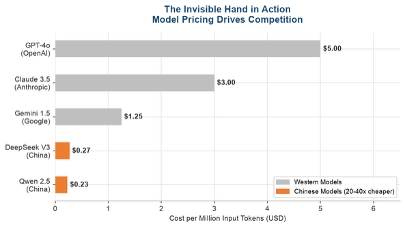
The most capable commercial models are not carrying the bulk of AI workloads. By token volume, users have migrated heavily toward Chinese models delivering comparable performance at 20 to 40 times lower cost. That is the invisible hand working exactly as Smith described – self-interest driving consumers toward better value, disciplining expensive incumbents without any regulator engineering the outcome.
The compute concentration concern is eroding just as fast. NVIDIA’s advantage is real, but AMD is closing the gap, and Google, Amazon, Microsoft, and Chinese fabs are all investing heavily in alternatives. This is the same cycle that broke every previous hardware monopoly.
“A $2,000 Mac Studio runs a capable 70B model locally. The economics of AI are democratizing faster than most people expected.”
More striking is what is happening at the edge. A $2,000 Mac Studio runs a capable 70B model locally. Open-weight models from Meta, Mistral, and DeepSeek mean the model itself is free. Once an organization owns the hardware and the weights, marginal cost per token approaches zero and data never leaves the building. For enterprises running AI at volume, the economics are already flipping from cloud to on-premise.
Smith would recognize this pattern immediately. The mainframe gave way to the minicomputer, which gave way to the PC, which gave way to the cloud, which may now be giving way to distributed, on-premise AI infrastructure owned by the organizations using it. Each transition was driven by the same force – innovation and competition collapsing the cost of a key input until it democratized. AI may follow the same arc as the PC: consequential not because it concentrated power, but because it distributed it.
The one concern Smith would take seriously is data. Compute and model weights are replicable. The proprietary datasets incumbents built over 20 years of user behavior are not. That is a durable structural advantage worth watching.
But the invisible hand is not broken in AI. It is working – and faster than most people expected.