The case for free trade in The Wealth of Nations rests on a simple observation: countries are not equally good at everything, and everyone benefits when each produces what it does best and trades for the rest. Even when one country is better at everything in absolute terms, relative advantage is what matters. Two and a half centuries later it remains the strongest intellectual argument for open trade.
Comparative advantage has always rested on factors genuinely hard to replicate across borders: natural resources, accumulated human capital, institutional frameworks, and tacit knowledge built over decades of doing something well. India built a services export economy on English-language education, engineering talent, and cost advantages. South Korea built semiconductor expertise through a generation of deliberate industrial policy. These advantages were real because they were difficult to replicate quickly. AI erodes the knowledge-based comparative advantages in ways still underappreciated.
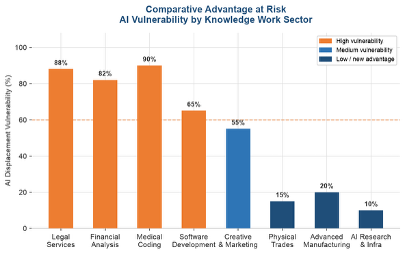
If a model can draft a legal brief, analyze a financial statement, or write production-grade code, then comparative advantages built on access to that expertise become fragile. The expertise is still valuable – but it is no longer as scarce, and scarcity is what gives comparative advantage its economic bite. Countries that built trade positions on being the most accessible source of a particular type of knowledge work are exposed when that work becomes automatable.
The most vulnerable are not countries that lack AI capability. They are the ones that built their economic positions on exporting exactly what AI replaces best. Service-export economies built on English-language advantage and large pools of educated, lower-cost knowledge workers are facing a structural shift in demand for their core export.
“Smith’s answer was not protectionism but investment – in education, in mobility, in the capacity to move toward new areas of strength.”
Smith would emphasize the transition question. Free trade creates winners and losers even when total wealth increases – gains accrue broadly but diffusely, while losses concentrate among workers in industries that can no longer compete. His answer was not protectionism but investment: in education, in mobility, in the capacity of workers to move toward new areas of strength.
The same logic applies here, at a larger scale and faster speed. The countries and companies that emerge with durable positions will be the ones that identify genuine comparative advantages in an AI-integrated economy and invest in them deliberately, rather than defending positions the technology has already made obsolete.
Smith’s framework is still sound. The map of who is strong at what has changed dramatically. Most of the people drawing policy have not caught up yet.