Adam Smith organized the economy around three factors of production: labor, land, and capital. Each earned its return – wages, rent, and profit. He did not present this as a neutral description. He was acutely aware of how power moved among the three groups, and he was consistently suspicious of capital owners in ways his free-market admirers prefer to leave out.
His core worry was rent – returns extracted from ownership of a scarce resource rather than from productive effort. He believed the natural tendency of unregulated economies was for rent to accumulate at the owners of scarce factors, at the expense of workers and consumers with no comparable leverage.
AI is a rent story. The scarce factor is compute, data, and model weights.
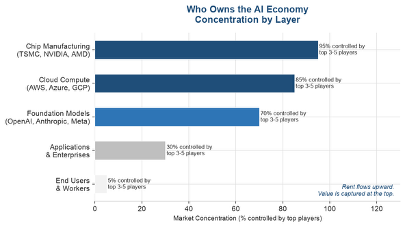
Training a competitive foundation model requires semiconductor clusters controlled by a small number of companies, training data only a handful of organizations have accumulated, and model weights encoding capabilities that take enormous capital to produce. Once a frontier model exists, deploying it costs almost nothing. But creating it excludes nearly everyone. Near-zero marginal cost on the output side, extreme barriers on the production side – that combination is almost perfectly designed to generate the rent Smith warned about.
The returns from AI-driven productivity will not distribute evenly. They will concentrate at the infrastructure layer and flow outward in diminishing amounts. A large share of the surplus will be extracted as rent by the entities controlling the scarce inputs – exactly as landowners extracted rent from agricultural productivity gains in pre-industrial Britain.
Training a competitive foundation model requires semiconductor clusters controlled by a small number of companies, training data only a handful of organizations have accumulated, and model weights encoding capabilities that take enormous capital to produce. Once a frontier model exists, deploying it costs almost nothing. But creating it excludes nearly everyone. Near-zero marginal cost on the output side, extreme barriers on the production side – that combination is almost perfectly designed to generate the rent Smith warned about. The returns from AI-driven productivity will not distribute evenly. They will concentrate at the infrastructure layer and flow outward in diminishing amounts. A large share of the surplus will be extracted as rent by the entities controlling the scarce inputs – exactly as landowners extracted rent from agricultural productivity gains in pre-industrial Britain.
This shows up in labor markets quickly. A knowledge worker whose output can be partially replicated by AI is not in the same negotiating position as five years ago. Productivity may increase, but leverage decreases because the employer now has an alternative that did not previously exist. Productivity gains and wage gains have always diverged in capitalism. AI is widening that gap fast.
Smith believed the wealth of nations was built by productive labor working with well-deployed capital under competitive conditions. He would look at the AI economy and see half that picture. The capital is extraordinary.
The question he would ask is who it is working for?